
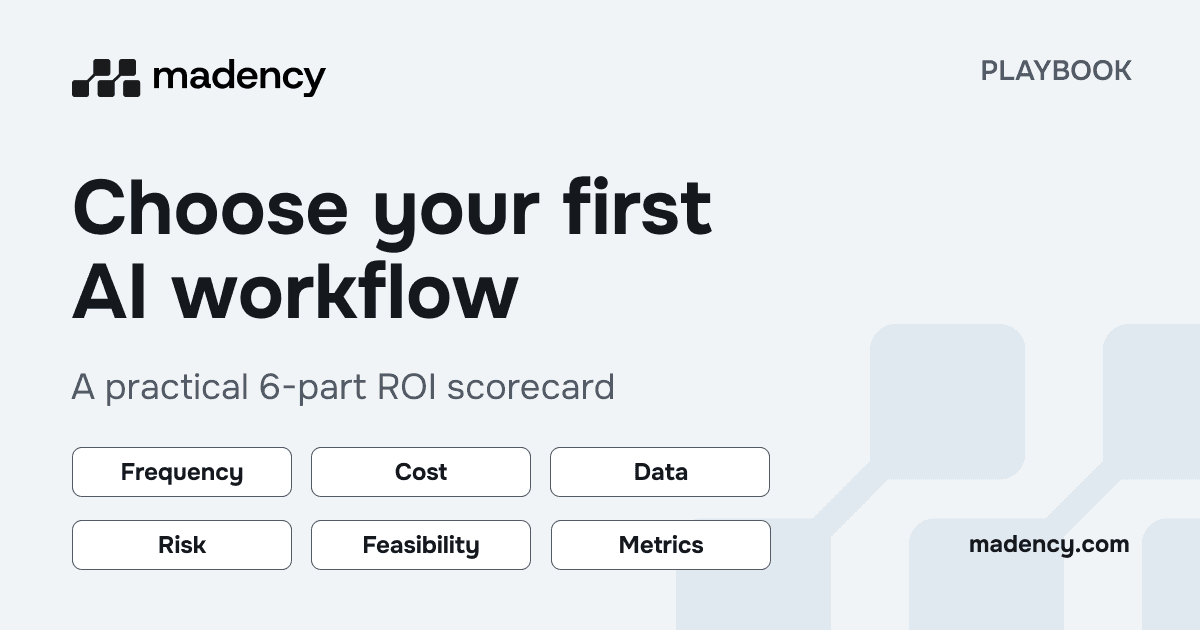
The best first AI workflow is usually not the most impressive one. It is the workflow that happens often, costs enough to matter, uses data you can reach, stays inside a safe boundary, and can be measured before and after implementation.
That makes the first decision less exciting—and much more useful. Instead of asking, “Where could we use AI?”, compare a few real workflows and ask, “Which one gives us the clearest opportunity to create measurable value without taking on unnecessary risk?”
This scorecard helps you make that comparison. It is a prioritization tool, not a financial forecast. A high score does not prove that a workflow should be automated. It shows which candidate is worth investigating first.
Start with workflows, not AI ideas
“We need an AI agent” is not a project definition. Neither is “we want to use our company data with AI.”
A useful starting point describes work that already happens:
- support requests are reviewed, categorized, and routed every day;
- sales managers assemble a pipeline summary every Friday;
- finance staff compare invoices with purchase orders;
- employees search across documents to answer recurring questions;
- operations teams copy information between a CRM, email, and spreadsheets.
These workflows have people, inputs, decisions, systems, and outcomes. That gives you something concrete to evaluate. It also makes it easier to decide whether AI is the right tool or whether the better answer is process redesign, cleaner data, or conventional automation.
If the workflow is still difficult to describe, use the AI Agent Readiness Checklist before scoring it.
The six-part AI workflow scorecard
Choose three to five candidate workflows. Score each one from 0 to 2 across the six dimensions below.
1. Frequency
How often does the workflow happen?
| Score | Definition |
|---|---|
| 0 | Rare, irregular, or one-off |
| 1 | Monthly |
| 2 | Weekly or daily |
Frequency matters because a small improvement compounds only when the work repeats. A painful task that happens once a year may still deserve attention, but it is rarely the best first AI workflow.
2. Current cost
What does the current process cost in time, delay, rework, or avoidable errors?
| Score | Definition |
|---|---|
| 0 | The cost is unknown or negligible |
| 1 | The workflow creates noticeable effort or delay |
| 2 | The workflow creates material recurring effort, delay, rework, or error cost |
You do not need a perfect financial model. Start with observable facts: people involved, hours spent, work waiting in queues, corrections required, and delays created for customers or other teams.
3. Data readiness
Can you name and access the information the workflow needs?
| Score | Definition |
|---|---|
| 0 | Sources are unknown, inaccessible, or not owned |
| 1 | Sources are known but fragmented or inconsistent |
| 2 | Sources are named, owned, and reachable |
Data does not become usable simply because it exists. “It is somewhere in the CRM” is not the same as knowing which records matter, who owns them, how current they are, and which permissions apply.
4. Action risk
What happens if the system gives the wrong answer or takes the wrong action?
| Score | Definition |
|---|---|
| 0 | A mistake could create serious financial, legal, customer, or operational harm, with no safe boundary |
| 1 | Human approval can contain the risk |
| 2 | The system reads, answers, classifies, or drafts inside a low-risk boundary |
The same workflow can receive a different score depending on the action level. Drafting a customer reply for review is safer than sending it automatically. Flagging an invoice mismatch is safer than approving payment.
5. Implementation feasibility
How narrow and understandable is the technical scope?
| Score | Definition |
|---|---|
| 0 | The workflow depends on many unknowns, legacy systems, or undefined rules |
| 1 | Several integrations or constraints are involved, but they can be identified |
| 2 | The workflow is narrow, with manageable integrations and clear boundaries |
Do not reward a workflow for sounding simple in a meeting. Identify the systems, handoffs, permissions, exceptions, and approval rules that make it work in practice.
6. Measurability
Can you tell whether the workflow improved?
| Score | Definition |
|---|---|
| 0 | There is no observable baseline or outcome |
| 1 | A useful proxy can be tracked |
| 2 | A baseline and target can be stated |
Useful measures include time per case, queue time, correction rate, percentage of work handled without escalation, response time, or the number of manual steps. Choose the measure before implementation, not after launch.
How to interpret the total
Add the six scores. The maximum is 12.
| Total | Interpretation |
|---|---|
| 10–12 | Strong candidate for Discovery |
| 7–9 | Promising, but clarify data, risk, feasibility, or measurement first |
| 0–6 | Probably not the first workflow to build |
The score is a filter. It helps you avoid spending weeks discussing a high-risk idea while a narrower, repeatable workflow with better data is waiting nearby.
Use this table to compare your candidates:
| Candidate workflow | Frequency | Current cost | Data readiness | Action risk | Feasibility | Measurability | Total |
|---|---|---|---|---|---|---|---|
| Workflow 1 | |||||||
| Workflow 2 | |||||||
| Workflow 3 |
Illustrative example: three workflows in one company
Consider a hypothetical 35-person service company comparing three ideas. The numbers below are illustrative. They are not customer results or ROI claims.
| Dimension | Support ticket triage and reply drafts | Weekly sales pipeline briefing | Autonomous price and contract negotiation |
|---|---|---|---|
| Frequency | 2 | 2 | 1 |
| Current cost | 2 | 1 | 2 |
| Data readiness | 2 | 1 | 1 |
| Action risk | 2 | 2 | 0 |
| Implementation feasibility | 2 | 1 | 0 |
| Measurability | 2 | 2 | 1 |
| Total | 12 | 9 | 5 |
Candidate 1: support ticket triage and reply drafts — 12/12
The work happens daily. The helpdesk and approved knowledge sources are known. The system can start by classifying requests and drafting replies while a person remains responsible for sending them. Baselines such as handling time, first-response time, routing accuracy, and correction rate can be recorded.
This score makes the workflow a strong candidate for Discovery. It does not mean the company should skip validation and move straight into a build.
Candidate 2: weekly sales pipeline briefing — 9/12
The workflow repeats every week and is low-risk because the first version only reads and summarizes information. But the data is fragmented across the CRM, spreadsheets, and email, and the team has not agreed on which fields are authoritative.
The idea is promising. Before building, the company should clarify source ownership, data quality, and the rules used to identify an at-risk deal.
Candidate 3: autonomous price and contract negotiation — 5/12
The potential business value may sound high, but the workflow combines commercial judgment, contract terms, exceptions, and high-impact external actions. The rules are not fully documented, and a mistake could affect margin or create a legal commitment.
This is a poor first AI workflow. A safer starting point could be retrieving approved terms, highlighting deviations, or drafting an internal recommendation for human review.
A high score does not prove ROI
The scorecard deliberately stays simple. It does not prove that:
- AI is better than conventional automation or process redesign;
- the data is accurate enough for production use;
- the team will adopt the new workflow;
- the expected benefit exceeds implementation and operating costs;
- the workflow meets security, privacy, or compliance requirements;
- every important exception has been identified.
Those questions require a closer look at the real process. That is the purpose of AI Strategy & Audit: map the workflow, validate the data and constraints, define the operating boundary, and decide whether there is a credible case to build.
You can also review How We Work to see how a fit call, Discovery, a fixed-scope build, and post-launch ownership connect.
What to bring to a fit call
You do not need a technical specification or a preferred AI model. Bring one repeated workflow and the best information you currently have:
- The trigger: What starts the workflow?
- The people: Who performs, reviews, or depends on the work?
- The steps: What happens from start to finish?
- The systems: Which tools and data sources are involved?
- The friction: Where do time, delays, rework, or errors appear?
- The boundary: What may the system answer, draft, recommend, or execute?
- The baseline: What can be measured before anything changes?
The guide on what to prepare before an AI Discovery session provides a fuller preparation checklist.
Choose the first workflow, not the final AI roadmap
The first project does not need to automate the most important decision in the company. It needs to create useful evidence: that the data can be reached, the workflow can be bounded, the team will use the result, and improvement can be measured.
Start with three candidates. Score them honestly. Then take the strongest one into a fit call.
Bring one repeated workflow. We will help you decide whether it is worth taking into Discovery.